








Le Bandit RTP and Volatility Without False Promises
Le Bandit has several important numbers that are easy to quote and easy to misunderstand. The useful figures are the RTP configurations, the provider volatility rating and the maximum win ceiling. None of them predicts the next spin, and none of them creates a strategy that can force the bonus or recover losses.
Four RTP configurations
Hacksaw Gaming lists four RTP configurations for Le Bandit: 96.34%, 94.23%, 92.17% and 88.36%. These are not four modes that a player switches inside the same game launch. The operator chooses the mathematical configuration that is offered to players. That means two visually identical Le Bandit launches can use different RTP values depending on the casino and market.
For real-money play, this is one of the first details to check in the loaded game's paytable or information screen. A higher RTP version is mathematically better over the long run, but it does not make short sessions stable. Even the highest listed value can produce a losing session, and a lower value can still produce a temporary win.
What RTP does not mean
RTP is calculated across a very large volume of stakes. A 96.34% RTP does not mean that a player who stakes 100 units will receive exactly 96.34 units back. It also does not mean that the slot is required to compensate after a poor sequence. Short-term results can move far above or below the theoretical value because the slot is random and feature results are uneven.
Volatility rating: 3 out of 5
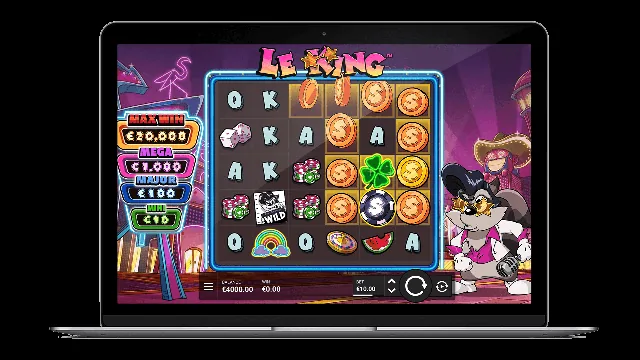
Le Bandit carries an official volatility rating of 3/5. On paper that is a middle rating on the provider scale, but the actual feel can still be sharp because Golden Squares, Rainbow, clovers and Pots of Gold can create concentrated feature moments. Volatility describes how results are distributed; it does not tell the player whether the next spin is likely to win.
This is why bankroll planning matters. A medium volatility label does not justify oversized stakes. The slot can still produce quiet stretches, especially if bonus triggers are delayed or if a feature opens without strong reveals.
Maximum win: 10,000x
The maximum win is capped at 10,000x the stake. This is a ceiling, not a normal target. It describes the strongest theoretical outcome the game can allow when the right chain of symbols, Golden Squares, multipliers and collection effects lines up. It should not be used as a reason to raise the stake.
How these numbers affect demo testing
In demo mode, use the statistics as context rather than a scoreboard. Check whether the paytable shows the RTP version, then watch how base-game wins compare with bonus rounds. Track whether long cascades and Golden Square activations are rare or frequent in your sample, but remember that the sample remains too small to prove future behavior.
Practical takeaway
The honest reading is simple: Le Bandit may run at 96.34%, 94.23%, 92.17% or 88.36% RTP depending on operator configuration; its volatility rating is 3/5; and its maximum win is 10,000x. These facts help set expectations, but they do not remove randomness. Choose the best available RTP version, keep stakes modest and treat the maximum win as a limit of the game, not a plan.
Budget example
If a player has a 100-unit entertainment budget, a 1-unit stake gives far more room to observe the game than a 5-unit stake. The RTP version is the same, but the session risk is very different. The lower stake allows more spins, more chances to see whether bonus timing feels comfortable and less pressure to chase one missed feature. That is the practical use of statistics: they help set a stake that fits the budget instead of encouraging a larger bet.